

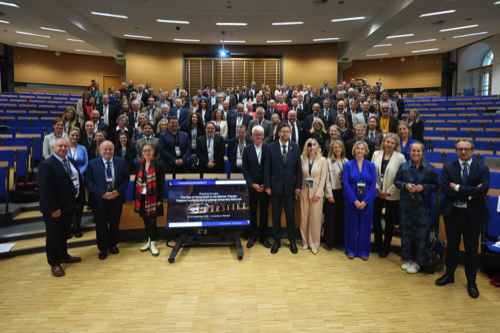
What role do European university alliances play in strengthening excellence, innovation and sovereignty? This was the topic of discussion among participants at the two-day conference entitled “Shaping Europe: The Role of Universities in the Weimar Triangle Trilateral Conference on European University Alliances”, which took place on 24th–25th September at the University of Warsaw.
The Committee for the Promotion of Franco-German-Polish Cooperation (the Weimar Triangle) was established in 1991 to foster dialogue and multi-level cooperation between the three signatory states. The role of university alliances in shaping this initiative today was the subject of a conference entitled ‘Shaping Europe: The Role of Universities in the Weimar Triangle Trilateral Conference on European University Alliances’, organised jointly by the University of Warsaw and the French and German embassies in Poland. The event’s partners were: the German Academic Exchange Service (DAAD), the French Embassy in Germany / Institut français de Pologne, the National Agency for Academic Exchange (NAWA) and Campus France.
“I have recently had the opportunity to give several lectures in the United States, Peru, Brazil and Japan. In each of them, the question arose: what is happening to the European Union? Is it heading towards its end? And what is the response of universities to this situation? The universities we represent here belong to numerous alliances. The University of Warsaw is part of the 4EU+ Alliance. Our collaboration is going extremely well in the areas of research, education, technology transfer and innovation. Thanks to this, we are able to compete with the world’s best universities and exert a real influence on the research policy of our country and of Europe as a whole,” said Prof. Alojzy Z. Nowak, Rector of the University of Warsaw.
“The first meeting of the Weimar Triangle took place in August 1991 in Weimar. When planning this conference, we weren’t thinking about specific dates or anniversaries. It is, however, a remarkable coincidence that our event is being organised exactly 35 years after that historic meeting. We have gathered here because we believe that Europe’s stability and future development must be founded on strong academic cooperation,” said Prof. Sambor Grucza, Vice-Rector for Cooperation and Human Resources at the University of Warsaw, as he welcomed the conference guests in the auditorium of the Old Library on the Main Campus.
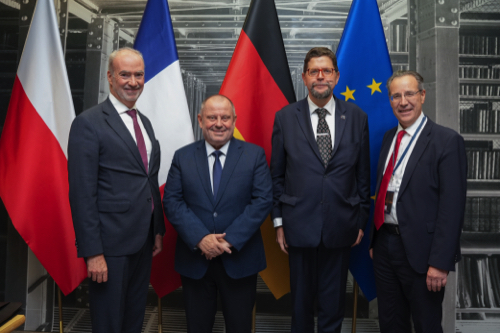
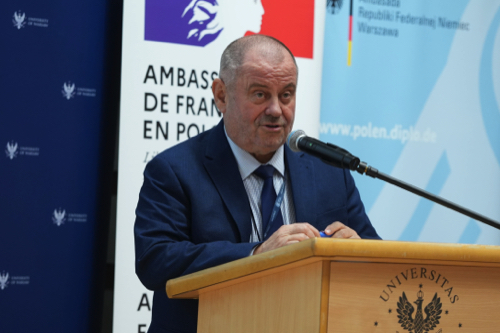
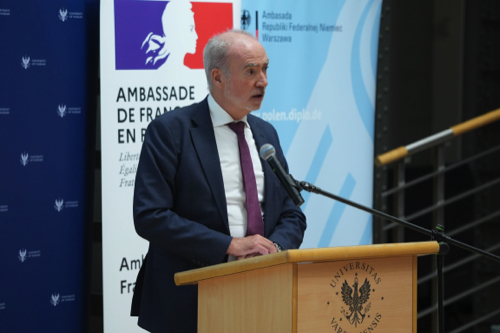
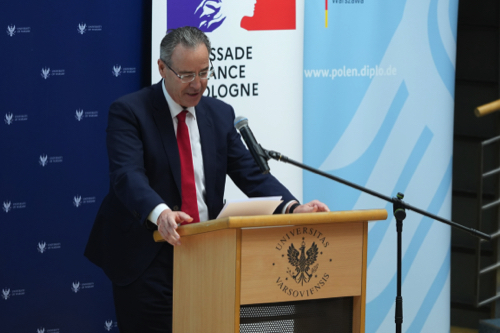
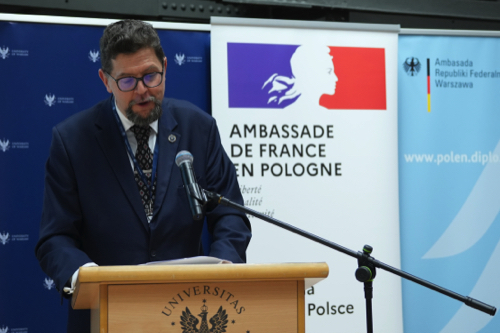
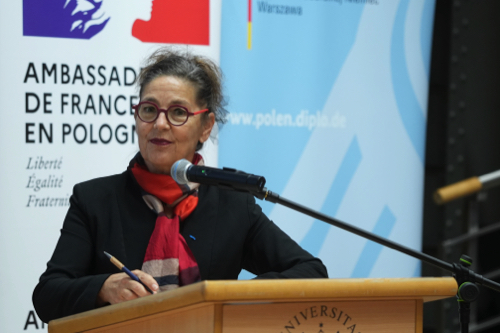
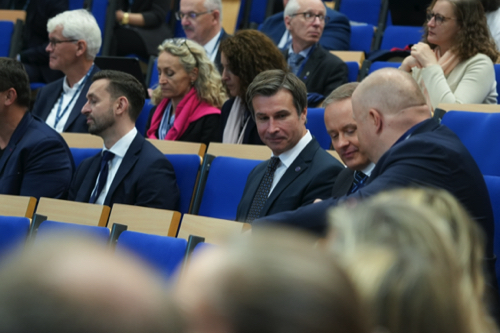
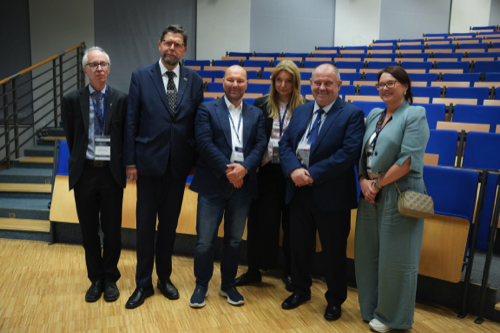
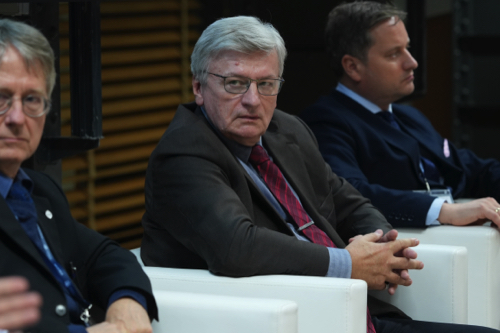
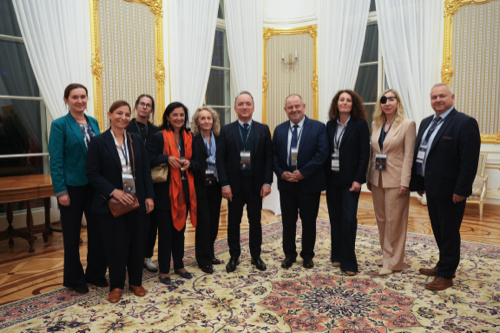
The event was attended by over 150 participants, including Étienne de Poncins (French Ambassador to Poland), Miguel Berger (German Ambassador to Poland), Prof. Andrzej Szeptycki (Undersecretary of State at the Ministry of Science and Higher Education), Lisette Andreae (Director of the Department for the European Higher Education Area and Internationalisation at the Federal Ministry of Education and Research), David Itier (Head of the European Strategy Unit at the French Ministry of Higher Education, Research and Space), Prof. Bogumiła Kaniewska (Chair of the Conference of Rectors of Polish Academic Universities, Rector of Adam Mickiewicz University in Poznań), Diana Jabłońska (Director for Youth, Education and the Erasmus+ Programme at the European Commission’s Directorate-General for Education, Youth, Sport and Culture), Prof. Beatrix Busse (Chair of the FOREU4ALL General Forum and the EUniWell Alliance), Dr Wojciech Karczewski (Director of NAWA), Dr Klaus Birk (Director of the Projects Department at the DAAD), Prof. Jerzy Małachowski (Director of the National Centre for Research and Development), Dr Jörn Achterberg (Deutsche Forschungsgemeinschaft), Dr Marcin Liana (Deputy Director of the National Science Centre), Katarzyna Aleksy (Director of the Higher Education Programmes Office, FRSE), Prof. Nourredine Manamanni (Director of External and Institutional Relations, Campus France), as well as representatives of European universities, educational institutions, PhD students and undergraduates.
On the first day, a lecture on the geopolitical dimensions of European university alliances was given by Prof. Emmanuelle Garnier, President of the University of Toulouse Jean Jaurès.
During the conference, a number of panels and sessions were held on the future of European university alliances, fostering academic cooperation within the Weimar Triangle, mobility programmes and degree programmes, collaborative research models within European university alliances, the careers of early-career researchers, and digital campuses.
The University of Warsaw was represented during the debates by: Prof. Zygmunt Lalak, Vice-Rector for Research; Prof. Maciej Raś, Vice-Rector for Student Affairs and Quality of Teaching and Learning; and Dr Robert Dąbrowski, Vice-Chancellor for IT.
The organisation of the event at the University of Warsaw was entrusted to the Office for International Research and Liaison, the local office of the 4EU+ Alliance at the University of Warsaw, the Office of the “Initiative of Excellence – Research University” Programme, and the Institute for Advanced Studies.
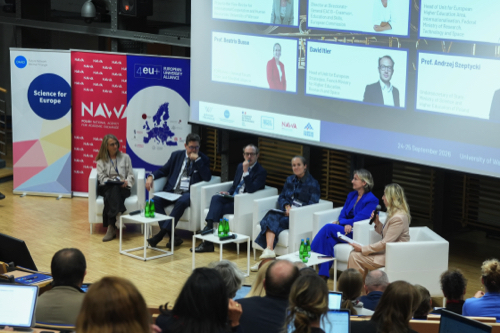
The 4EU+ Alliance
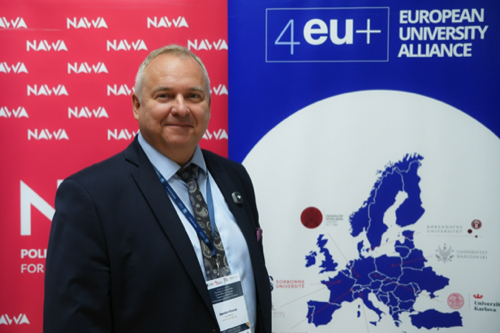
The University of Warsaw is a member of the 4EU+ Alliance. The eight universities in the Alliance jointly conduct research and educate students, and develop initiatives relating to innovation, technology transfer and the social responsibility of higher education institutions. The challenges facing the 4EU+ partners include increasing mobility, which will be important for all universities, deepening integration and improving balance at European level, and establishing a common framework for education.
The conference on the Weimar Academic Triangle was attended by, amongst others, Elena Del Giorgio, Secretary-General of the 4EU+ Alliance, as well as representatives from the universities of Heidelberg, Sorbonne and Paris-Panthéon-Assas.