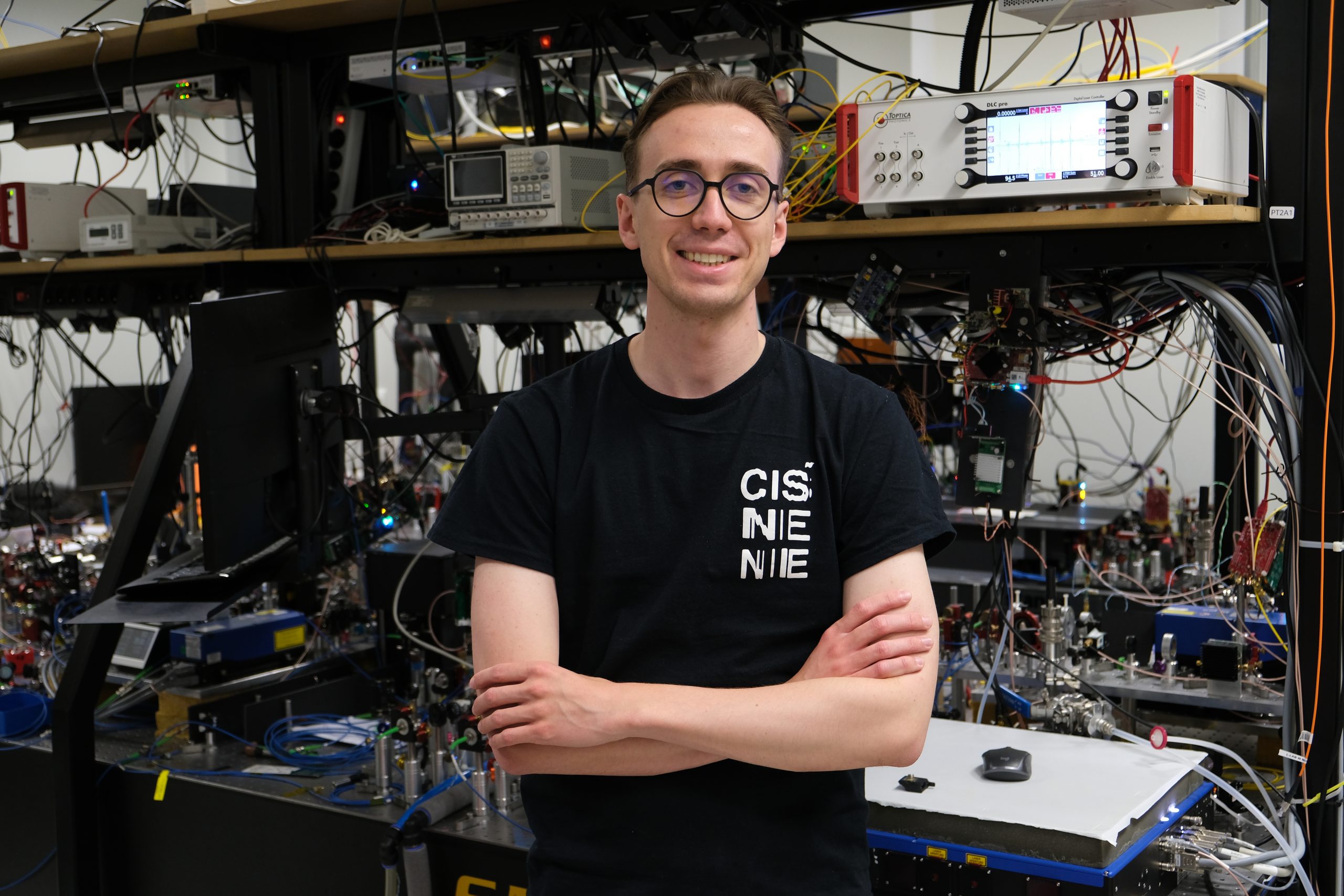


Bartosz Kasza, a doctoral candidate at the UW’s Faculty of Physics and a researcher at the UW’s Centre for New Technologies, has been awarded a prize by the International Society for Optics and Photonics (SPIE). The doctoral candidate from the UW is the sole representative of Polish universities amongst the 85 winners from around the world.
Bartosz Kasza is conducting his research at the Quantum Optical Devices Laboratory (QODL) at the Centre for Optical Quantum Technologies (CeNT). Under the supervision of Prof. Michał Parniak and Prof. Wojciech Wasilewski – members of the Department of Optics at the Institute of Physics and Dynamics (IFD) within the Faculty of Physics and CeNT at the UW – work is being carried out there on high-precision microwave radiation detectors based on Rydberg atoms, i.e. alkali atoms excited to very high energy states.
Atomic modelling and microwave frequency combs
“In my day-to-day work, I model the interactions between Rydberg atoms and light – in order to explain the results of measurements carried out by my colleagues in the laboratory,” explains Bartosz Kasza.
The results of this work are described in an article published in the journal Optica (Bartosz Kasza is a co-author of this paper). Using atoms, the team succeeded in converting a microwave frequency comb into the optical domain. The researchers successfully modelled the behaviour of the atoms and explained how multiphoton resonances translate into photon transduction, which forms the basis of the converter they built.
In addition to his research activities, Bartosz Kasza is actively involved in the development of the UW’s research society Koło Naukowe Optyki i Fotoniki (KNOF). Last year, he served as vice-president and was responsible for organising the innovative series of meetings entitled “Iluminacje”. They provided a platform for the exchange of experiences between doctoral candidates, professionals from the photonics and optics industry, and students of the Faculty of Physics.
“This experience enabled many students to establish valuable contacts within the industry, receive advice on choosing a research group at the Faculty, and even secure summer placements,” sums up the award winner.
The full list of award winners can be found on the SPIE website – spie.org >>