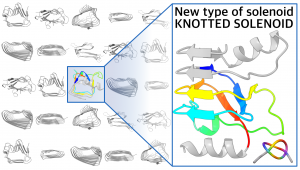


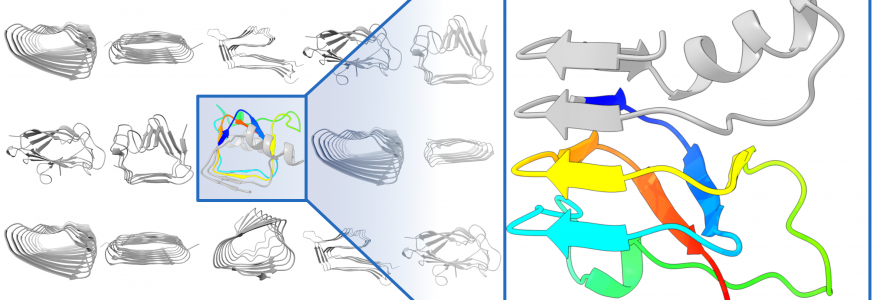
An international team of scientists led by Prof. Joanna Sułkowska from the Centre of New Technologies at the University of Warsaw has published research findings in the journal “Proceedings of the National Academy of Sciences” that are changing our understanding of the architecture of life. The researchers have described the first crystal structures of proteins with a previously unknown motif among solenoid-type proteins – so-called Knotted Solenoids.
Crucially, the existence of this unique form had previously been suggested by artificial intelligence (AlphaFold), although it seemed unlikely. Nevertheless, the Polish research has provided definitive, experimental proof that AI algorithms are capable of accurately modelling even the most topologically complex secrets of nature.
A unique structural motif
These proteins resemble tightly coiled, repeating helices (solenoids). The uniqueness of this motif lies in a specific shift in the chain via the so-called ‘skip-and-backtrack’ mechanism. In this process, one turn of the helix deliberately skips the periodicity. This subtle change causes the molecule to tie itself into a three-leaf knot (31).
“The discovery of this structure and its interpretation were made possible by an interdisciplinary approach combining experimental research and the latest AI algorithms. The publication resulted from detailed studies of chemical and thermal stability in collaboration with Prof. Sophie Jackson of Cambridge University and the Department of Biophysics at the UW’s Faculty of Physics. The results of the experimental studies were interpreted using classical numerical simulations and AI methods that allow for sampling a wide range of the energy landscape, and consequently for developing theories of the folding of new protein folds. On the other hand, we have demonstrated that this specific motif occurs in a particular group of bacteria and is evolutionarily conserved despite the enormous variability in the amino acid sequence – the researchers explain.
Evolutionary pressure and improved quality of life
The discovery of knotted proteins within a family of structures previously thought to be knot-free represents a completely new frontier for science. It offers a unique opportunity to investigate how evolutionary pressure and the presence of knots influence the formation of protein architecture and their functions. The presence of stable, evolutionarily conserved elements within the very core of the knot suggests that this looping plays a key biological or structural role. Many solenoid-structured proteins are involved in disease processes, including bacterial infections and neurodegenerative diseases. Knowledge of their ‘knotted’ nature enables the development of therapies that block their action more precisely and effectively, opening up a range of new applications in medicine.
“These new discoveries help us better understand the processes responsible for changes in protein architecture over millions of years. They show that to explain the stability of enzymes, we must consider more factors than just the amino acid sequence itself, including topology and evolutionary origin,” the study authors conclude.
Publication details
Sikora, M. Mozajew, J.A. Sikorska, F.B. da Silva, A.P. Perlinska, A. Kluza, S. Niewieczerzal, M. Lukaszewicz, B. Wielgus-Kutrowska, K. Stachurska-Korzeniowska, S.E. Jackson, & J.I. Sulkowska, Novel Knotted Solenoid fold with order-shifted coil arrangement leads to nontrivial 31 topology, “Proc. Natl. Acad. Sci. U.S.A.” 123 (17) e2525920123,