


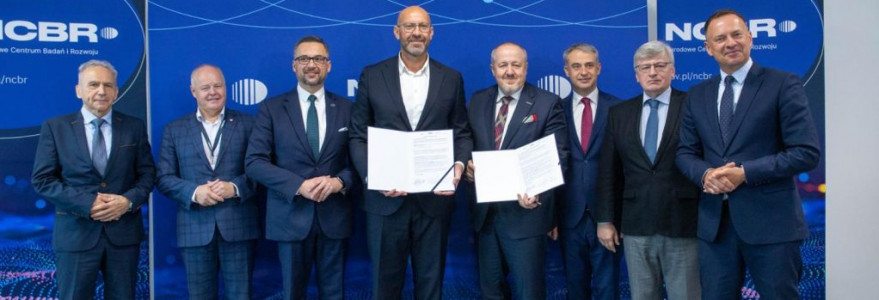
The University of Warsaw, together with the AGH University of Krakow, will carry out the MAPTur project. The result will be a state-of-the-art platform using artificial intelligence to monitor, analyse and forecast tourist traffic in Poland. The project was selected for funding in the 8th call for proposals under the INFOSTRATEG programme of the National Centre for Research and Development, implemented in cooperation with the Ministry of Sport and Tourism.
On 11th June, a conference was held at the headquarters of the National Centre for Research and Development to launch the eighth call for proposals under the INFOSTRATEG programme, focusing on the use of artificial intelligence to promote economic development in the tourism sector.
The conference was attended by Dr Krzysztof Gawkowski, Deputy Prime Minister and Minister for Digital Affairs; Dr Marcin Kulasek, Minister for Science and Higher Education; Jakub Rutnicki, Minister for Sport and Tourism; Prof. Jerzy Małachowski, Director of the National Centre for Research and Development; and representatives of institutions implementing the projects, including Prof. Zygmunt Lalak, the UW Vice-Rector for Research.
The MAPTur project is being carried out by the University of Warsaw in a consortium with the AGH University in Krakow. It addresses the challenges associated with the lack of integrated, precise and robust tools for the comprehensive analysis and forecasting of phenomena occurring in the tourism sector.
“The MAPTur project fits perfectly with the University of Warsaw’s strategy of developing research at the intersection of the social sciences, the natural sciences and new technologies. It combines expertise in mathematical modelling, big data analysis and artificial intelligence to address real socio-economic challenges. We are delighted that our researchers’ expertise will be used to create a tool supporting the development of Polish tourism and decision-making processes within public administration,” says Prof. Zygmunt Lalak, the UW Vice-Rector for Research.
The UW’s Interdisciplinary Centre for Mathematical and Computational Modelling (ICM) plays a key role in the project; its team is responsible for developing methods of data analysis, spatial behaviour modelling and forecasting tourist flows using artificial intelligence.
“The key challenges addressed by our project are the scattered nature, low spatial resolution and patchy nature of currently available data; the lack of models enabling precise forecasting of tourism-related phenomena over time and space; and the lack of knowledge regarding the profiles and specific spatial behaviours of visitors,” says Dr Franciszek Rakowski, project R&D manager at ICM UW, adding: “Our team includes specialists in population dynamics, phenomena occurring in the tourism sector, and the mathematical modelling of complex population systems.”
Digital twin
The MAPTur project will be implemented in stages. First, a data collection system resistant to gaps and disruptions will be developed. Next, the researchers will create a digital twin – a synthetic environment that replicates the spatial behaviour of the real-world population.
The next stages will involve the use of advanced artificial intelligence models, including deep neural networks, to forecast short- and long-term trends in tourist traffic. The team will also carry out empirical research and integrate the results with available public statistics in order to verify and refine the algorithms. The end result will be the creation of a user-friendly platform presenting the results of the analyses and forecasts.
The project’s results will be applied in both the public and commercial sectors. The tool is designed to support public administration, local authorities and businesses in making decisions regarding tourism development, investment planning and the management of tourist flows in a more effective and sustainable manner.
The 8th INFOSTRATEG competition is a multi-stage contest. Two projects have been selected for funding and will compete to progress to the next implementation phases. Only one of them will qualify for the final stage, and the solution, ready for implementation, is due to be developed by the end of 2029.