


The formation of epidermal combs is the subject of an article co-authored by researchers from the Centre of New Technologies at the University of Warsaw – Prof. Krzysztof Kobielak and Dr Anna Puławska-Czub. The publication was published in the “Nature” journal.
An international team of researchers from the University of Warsaw, Washington State University, Wuhan University, the University of California Irvine, The University of Texas at San Antonio, the University of Iowa, and other scientific institutions has published the results of its research on the formation of epidermal ridges – a process that occurs through evolutionarily distinct mechanisms in mammalian skin– in the prestigious “Nature” journal.
The co-authors of the publication Rete ridges form via evolutionarily distinct mechanisms in mammalian skin are Prof. Krzysztof Kobielak, Head of the Laboratory of Stem Cells, Tissue Development and Regeneration at the Centre of New Technologies at the University of Warsaw, and Dr Anna Puławska-Czub from the same group.
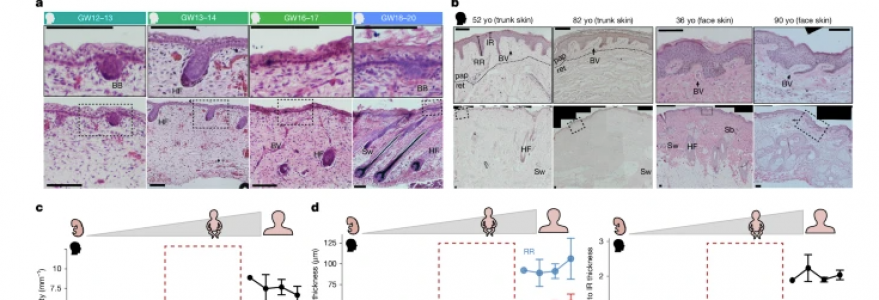
Hair loss in the course of human evolution has long been a subject of interest to both scientists and the general public. The reduction in hair density coincided with the appearance of epidermal ridges (rete), whose developmental timing and molecular mechanisms remain poorly understood, despite their clear presence in humans. Analysis of human and pig skin development has shown that epidermal combs are formed by a mechanism independent of the mechanisms of hair follicle and sweat gland formation, through the establishment of interconnected epidermal invaginations.
“In our study, we show that the evolution of epidermal combs in mammalian skin was associated with the replacement of the molecular program responsible for the formation of discrete microscopic skin appendages, including hair follicles and sweat glands, with a separate program leading to the formation of an interconnected network of appendages. Extensive activation of BMP signalling in the epidermis is essential for the development of a network of epidermal ridges organised around the underlying dermal pockets,” says Prof. Krzysztof Kobielak.
The research results were published in the “Nature” journal: