


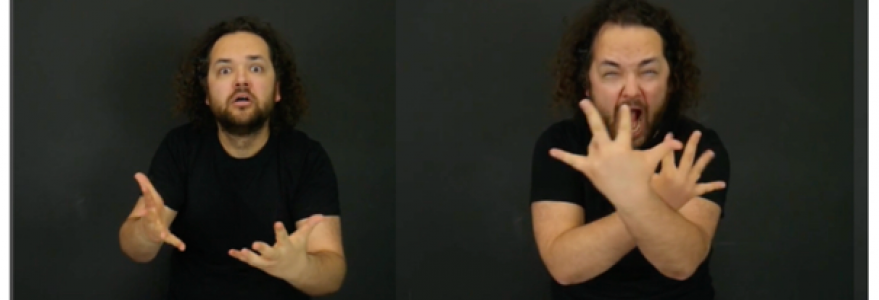
Researchers from the University of Warsaw have shown that stories told in sign language, using hand gestures and facial expressions, synchronise our brain activity in a similar way to stories told through speech. An article presenting the research findings was published in the journal “Nature Communications”.
The research was carried out by a team comprising Dr Maria Zimmermann from the UW’s Faculty of Psychology and the Department of Psychology and Brain Sciences at Johns Hopkins University (Baltimore, USA), Prof. Piotr Tomaszewski from the UW’s Faculty of Psychology, Prof. Marina Bedny from the Department of Psychology and Brain Sciences at Johns Hopkins University (Baltimore, USA), Prof. Artur Marchewka from the Brain Imaging Laboratory at the Institute of Experimental Biology of the Polish Academy of Sciences, and Prof. Marcin Szwed from the Institute of Psychology at the Jagiellonian University.
Common features of spoken and sign languages
Like spoken languages, sign languages have a rich vocabulary, employ generative grammatical rules and morphological structures, and are capable of conveying complex narratives. They also have their own distinctive features, involving the use of the hands, facial expressions, eye contact, head movements and the entire torso to convey information.
From a neurobiological perspective, sign language and spoken language also share fundamental characteristics. Previous research suggests that, like spoken languages, sign languages rely on the left-sided neural network comprising the 22–34 frontal-temporal nerves. In both sign language and spoken language, the left inferior frontal cortex and lateral temporal cortex are active during the processing of words and grammatical elements.
Synchronisation
Storytelling is a way of sharing ideas, beliefs, and feelings. When people listen to stories told in spoken language, their brains synchronise. Scientists have shown that the same thing happens when we tell stories in sign language. In addition to synchronising the systems responsible for language and narrative processing, stories told in sign language also synchronise the areas of the brain responsible for spatial perception and the processing of facial expressions. These findings reveal both universal and sign-language-specific neural signatures of language and storytelling. The study provides rare neuroscientific evidence on how deaf people process narratives and highlights the linguistic richness of sign languages. Functional magnetic resonance imaging (fMRI) was used in the research.