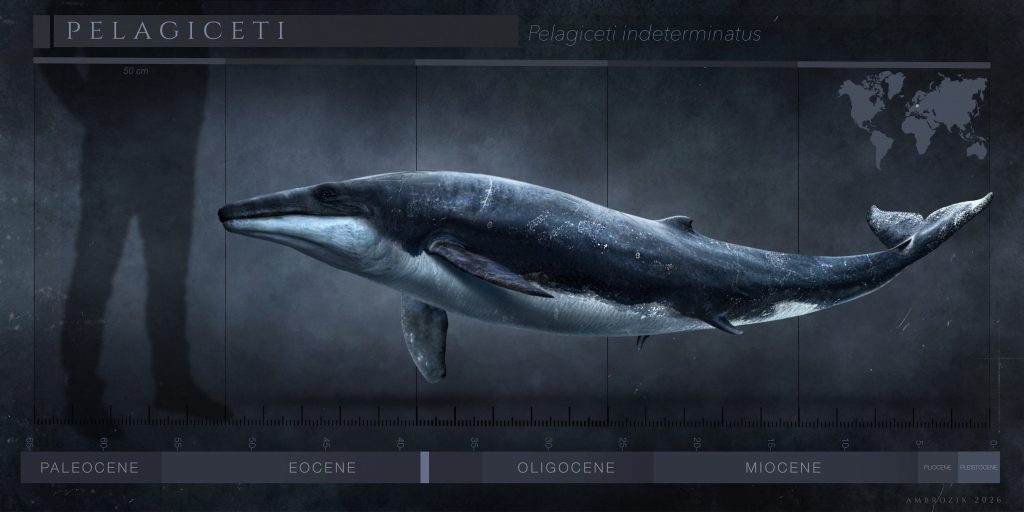


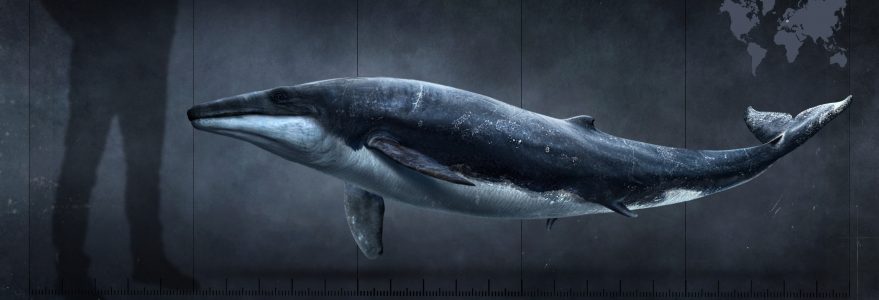
The remains of a cetacean dating back 38 million years have been discovered in the Lublin Voivodeship. This is the first specimen of its kind from the Eocene and Palaeogene periods to be found in Poland. The research was led by Dr Daniel Tyborowski from the UW’s Faculty of Geology.
Until now, Eocene cetaceans in this part of Europe were known only from Ukraine and Germany. The cetacean discovered by the Polish team is comparable in size to modern-day dolphins. The results of the research have been published in the scientific journal “The Anatomical Record”.
The sea covered Ukraine, Poland and Germany
Cetaceans are the mammals that were the first to fully adapt to life in a marine environment. Their evolutionary history dates back nearly 50 million years, when the land-dwelling ancestors of these animals began to lead a semi-aquatic lifestyle. The first fully aquatic cetaceans appeared in the Eocene (the second epoch of the Palaeogene period) over 40 million years ago. Just a few million years later, there were already giant cetaceans reaching almost 20 metres in length.
Until now, Poland had been a blank spot in terms of finds of early cetacean bones. This changed when, in an amber mine near Lubartów in the Lublin Voivodeship, Dr Lucjan Gazda, a geologist from the University College of Applied Sciences in Chełm, discovered a cetacean jawbone in rocks dating back 38 million years. During the Eocene, the Lublin region formed the northern edge of a small landmass. Nearby, an ancient river flowed into a shallow sea that covered Ukraine, Poland and Germany. Amber deposits formed in the coastal zones of this body of water, but the conditions at the seabed were equally favourable for the preservation of organism remains. The discovery of cetacean bones in such sediments was expected – Eocene cetacean remains are commonly found in Ukraine and northern Germany. At that time, these areas were covered by the same sea, so the cetaceans inhabiting them must have migrated east-west across Poland.
Cetaceans versus sharks
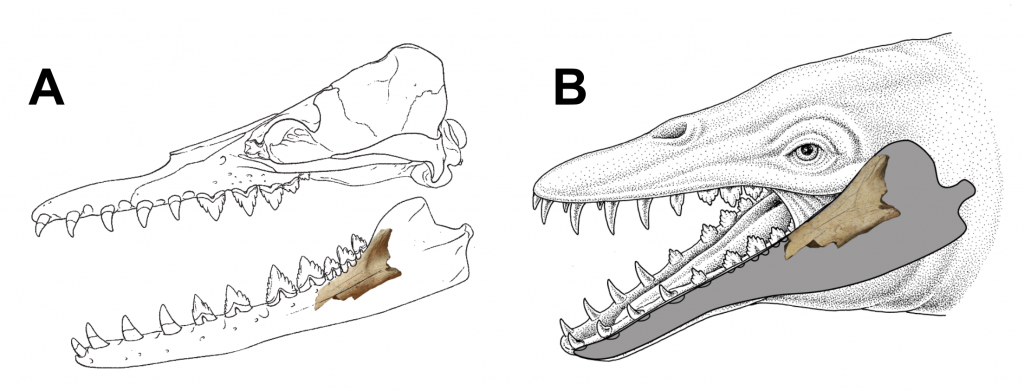
The discovered specimen is a fragment of a lower jaw with preserved tooth sockets. The research was led by Dr Daniel Tyborowski, a palaeontologist from the Faculty of Geology at the University of Warsaw. The co-authors of the study are Dr Svitozar Davydenko and Prof. Pavel Gol’din from the Schmalhausen Zoological Institute in Kyiv, Weronika Wierny from the Polish Geological Institute – National Research Institute in Warsaw, and Dr Lucjan Gazda from the University College of Applied Sciences in Chełm.
“It turned out that the ‘Polish’ proto-cetacean was small in size, reaching between 1.7 and 2.1 metres in length, which is comparable in size to today’s dolphins. Until now, it was thought that during the Eocene, cetaceans increased in size and successive forms became larger and larger. The Polish find shows that the Eocene was a time of general diversification among early cetaceans and the occupation of various ecological niches,” says Dr Tyborowski.
Most likely, the small cetacean from near Lubartów was a fish-eater and hunted shoals of small fish in coastal waters and near river mouths. This discovery shows that cetaceans occupied diverse ecological niches even in the early stages of colonising marine ecosystems. In Polish waters, however, the small cetacean would have had to be on its guard and flee from the menacing jaws of the giant sharks that ruled these waters.
Article:
Tyborowski, D., Davydenko, S., Wierny, W., Gol’din, P., & Gazda, L. (2026). The first Pelagiceti whale from the Eocene of Poland with its evolutionary and biogeographic significance. “The Anatomical Record”, 1–11.