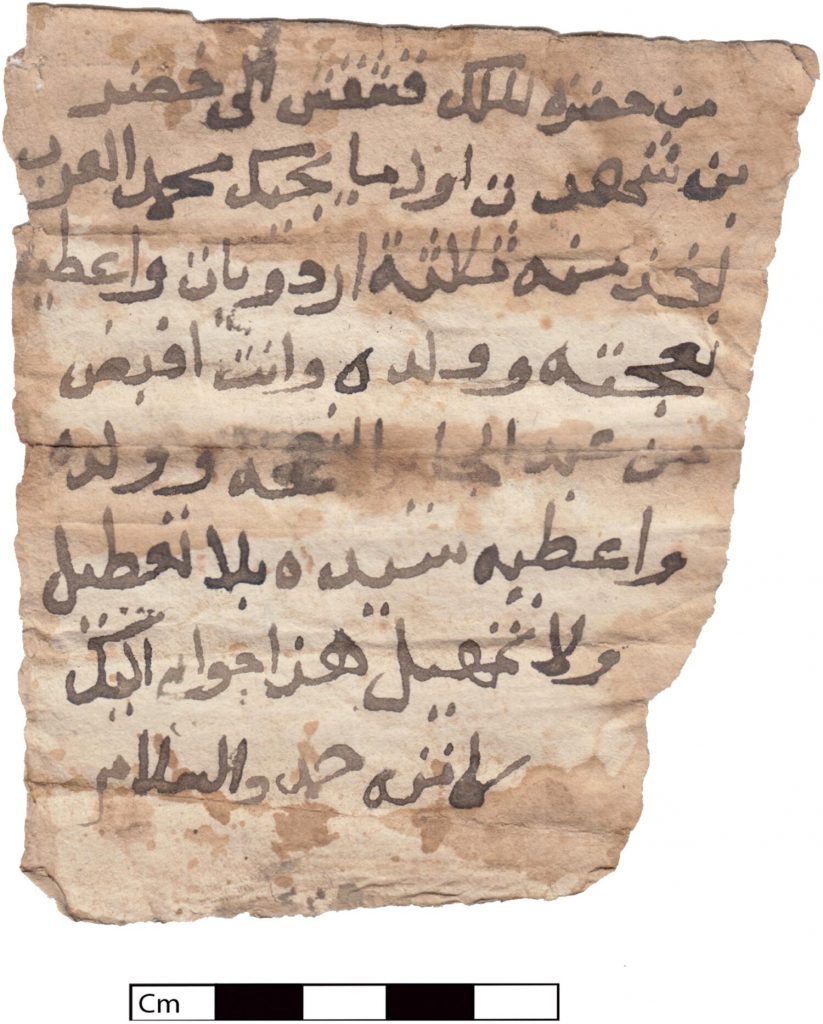


Archaeologists from the University of Warsaw have confirmed the existence of King Qashqash. An article by researchers from the UW’s Polish Centre of Mediterranean Archaeology presents new historical evidence from Old Dongola. An Arabic document discovered during excavations confirms the existence of a ruler who had previously been considered semi-legendary.
The publication in the journal “Azania: Archaeological Research in Africa” is one of the first results of research on Arabic documents found in Old Dongola. They are being analysed by a team led by Tomasz Barański from the UW’s Polish Centre of Mediterranean Archaeology (CAŚ).
The finds include letters, administrative and legal texts, as well as amulets. These documents provide a better understanding of the history of the city located in the central Nile Valley.
The legendary king of Nubia
The discovery of King Qashqash’s written order provides direct evidence of the historical existence of this figure, previously known only from brief mentions in a hagiographic work from the early 19th century.
“Although the content of the letter is relatively simple, the document provides a unique insight into the socio-economic relations of the Kingdom of Dongola during a period of intense Arabisation and Islamisation, as well as into the relations between the ruler and his subjects,” says Tomasz Barański, adding: “It can be assumed that Qashqash and his court efficiently managed the distribution of material goods and social prestige within the traditional royal patronage system.”
The find is also of great importance for research into linguistic changes in the region. The document shows that at the turn of the 16th and 17th centuries, Arabic was already used by scribes serving the heirs of Makuria. However, it is not known whether it was commonly used at the royal court in Dongola or in communities further away from the centre of power, which probably continued to use a local variety of the Nubian language. These conclusions are important for research on the pace and scope of the Islamisation process and the formation of Arab identity in the region of present-day Sudan.
The manuscript was written on paper and has been preserved in its entirety, unlike many other documents from this site, which have survived only in fragments. As Tomasz Barański notes, the language and calligraphy indicate a writing style that was not yet fully developed.
“However, non-standard grammatical forms and the scribe’s unsophisticated handwriting are not surprising in an environment where Arabic was not yet the native language. The irregular shape of the paper also suggests that the preserved text may have been only a draft of the actual document,” explains the researcher.
The King’s House
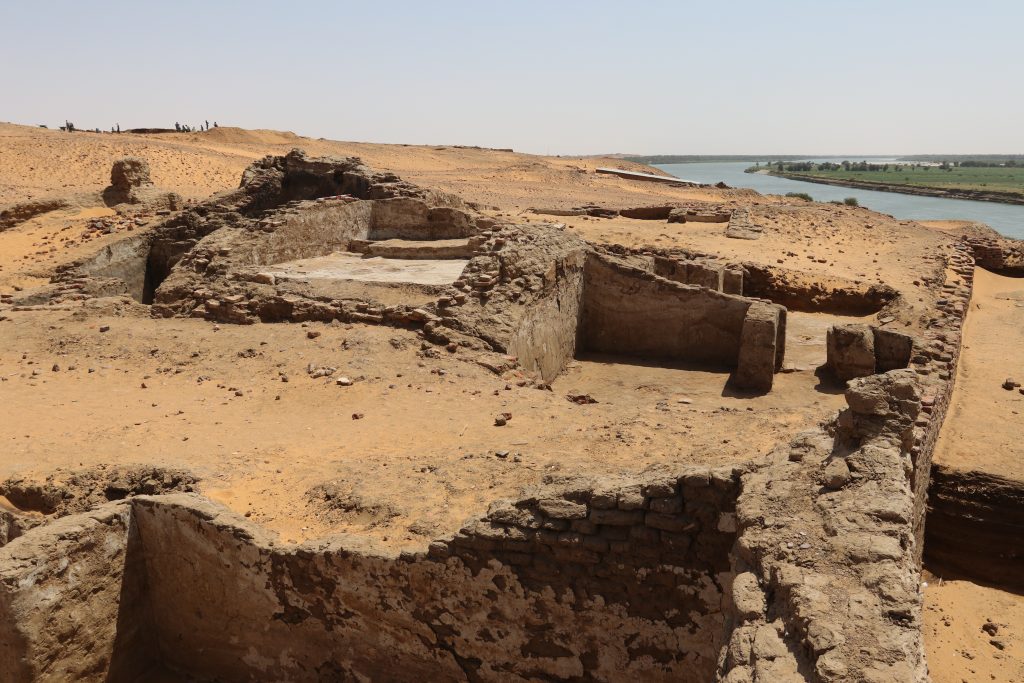
King Qashqash’s order was discovered in a magnificent residential building. Inside, archaeologists found numerous items testifying to the elite nature of the building, including cotton, linen, and silk fabrics, ivory and rhino horn products, and over 20 Arabic documents. Interestingly, the building is still referred to by local residents as the “King’s House”. The discovery of the order in this very place is another argument supporting the traditional identification of the ruins preserved in local oral traditions.
As emphasised by Prof. Artur Obłuski, director of the CAŚ UW and head of the ERC project Urban Metamorphosis of the Community of a Medieval African Capital City (UMMA), under which research was conducted in Dongola in 2021, archaeologists from the UW are working closely with the inhabitants of the city and its surroundings.
“They are our partners in research. We learn from each other and exchange knowledge. Thanks to this, we know that the figure of King Qashqash still lives on in local memory. What is more, his descendants still live in the vicinity of Dongola today,” emphasises Prof. Obłuski.
Publication:
Barański, A. Obłuski, M. Wyżgoł, The King of Nubia at work: archaeological context and text edition of a sixteenth/seventeenth-century Arabic document from Old Dongola, Azania: Archaeological Research in Africa, (2026). DOI: 10.1080/0067270x.2026.2615518