


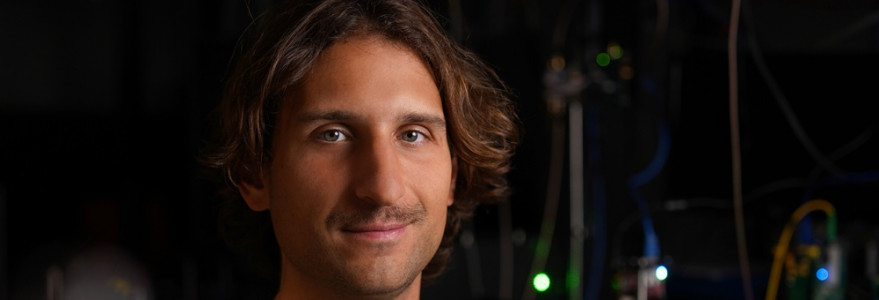
“In the QURA project, we are proposing a paradigm shift: instead of measuring waves using metal, we are using Rydberg atoms, which act as natural and extremely sensitive quantum sensors,” says Prof. Michał Parniak from the Faculty of Physics and the Centre of New Technologies at the UW, a recipient of the prestigious Starting Grant from the European Research Council (ERC). Together with his team, the scientist will develop quantum sensors to measure electromagnetic fields in the microwave, millimetre-wave and terahertz ranges.
Prof. Michał Parniak from the Faculty of Physics and the Centre of New Technologies at the UW has received a Starting Grant from the European Research Council (ERC) to carry out the project “Quantum Rydberg Antenna Systems” (QURA).
The researcher, together with his team, plans to build groundbreaking quantum sensors for measuring electromagnetic fields in the microwave, millimetre-wave and terahertz ranges. The project aims to overcome the fundamental noise and sensitivity limitations of classical electronics by utilising methods from quantum optics and atomic physics.
The ERC grant amounts to €2 million.
“Existing electronics based on conventional metal antennas are approaching their physical limits in terms of sensitivity and bandwidth. In the QURA project, we propose a paradigm shift: instead of measuring waves using metal, we use Rydberg atoms, which act as natural and extremely sensitive quantum sensors. This allows for the direct measurement of electromagnetic fields with unprecedented precision and the counting of individual microwave photons at room temperature. This opens the door to groundbreaking technologies in 6G communications, radar and astronomy,” says Prof. Michał Parniak, the ERC grant holder.
Quantum antennas
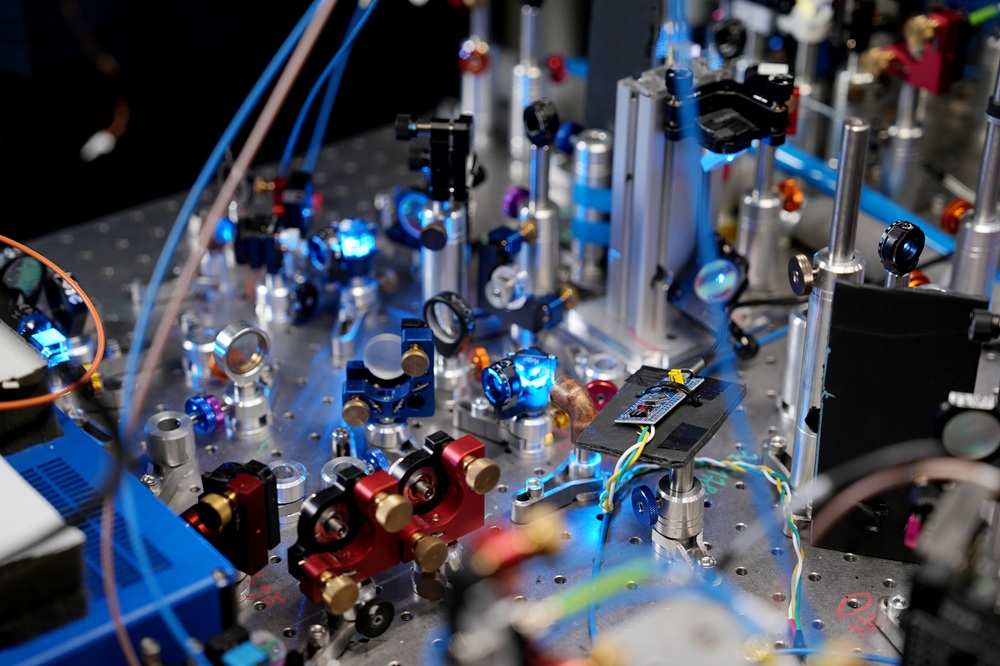
The researchers will analyse the interaction of electromagnetic waves with atomic gases excited to Rydberg states with enormous dipole moments. To this end, they will utilise methods from quantum and laser optics, such as superheterodyne detection, electromagnetically induced transparency (EIT) and direct counting of microwave photons. The research will be conducted in parallel on cells containing hot atomic vapour and on ultracold atoms trapped in optical traps.
“The innovative aspect of the project lies in moving away from conventional metal receiving elements in favour of ‘quantum antennas’ based on collective atomic excitations. This allows us to achieve sensitivity at the level of single microwave photons at room temperature, without the need for cryogenic cooling,” emphasises Prof. Parniak.
The project will yield new insights into quantum metrology and the physics of atomic systems. The researchers plan to develop a mobile quantum radiometer for measuring the sky, as well as quantum antenna array demonstrators ready for application testing.
The project’s outcomes may have future practical applications, including high-bandwidth 6G wireless networks, ultra -sensitive and hard-to-detect passive radar systems, space radiometry – including precise measurements of microwave background radiation – and quantum interfaces for communication in quantum networks.
The project will last five years. It is scheduled to commence in early 2027.



Prof. Michał Parniak from the Institute of Experimental Physics at the Faculty of Physics and the Centre of New Technologies at the UW is the leader of the Quantum Optical Devices Lab research group at the UW’s Centre for Optical Quantum Technologies. He obtained his doctoral degree in physics (2019) and his habilitation (2023) with distinction from the University of Warsaw.
He gained international experience at the QUANTOP centre at the Niels Bohr Institute, University of Copenhagen, and at the Institute of Photonic Sciences (ICFO) in Spain. He is the recipient of the Frank Wilczek Prize (2022), the Wojciech Rubinowicz Scientific Prize (2023), the KCIK Award (2020), the Prof. Stefan Pieńkowski Award (2025), an FNP START fellowship with distinction, and the Ministry of Science and Higher Education’s Diamond Grant.
Prof. Parniak leads numerous NCN projects and the international RYDAR project funded by the European Space Agency (ESA). He is the author of over 45 publications in leading journals (including “Nature Physics,” “Nature Photonics,” “Nature Communications,” “Physical Review Letters” and “Optica”) and a co-inventor on four granted patents.